
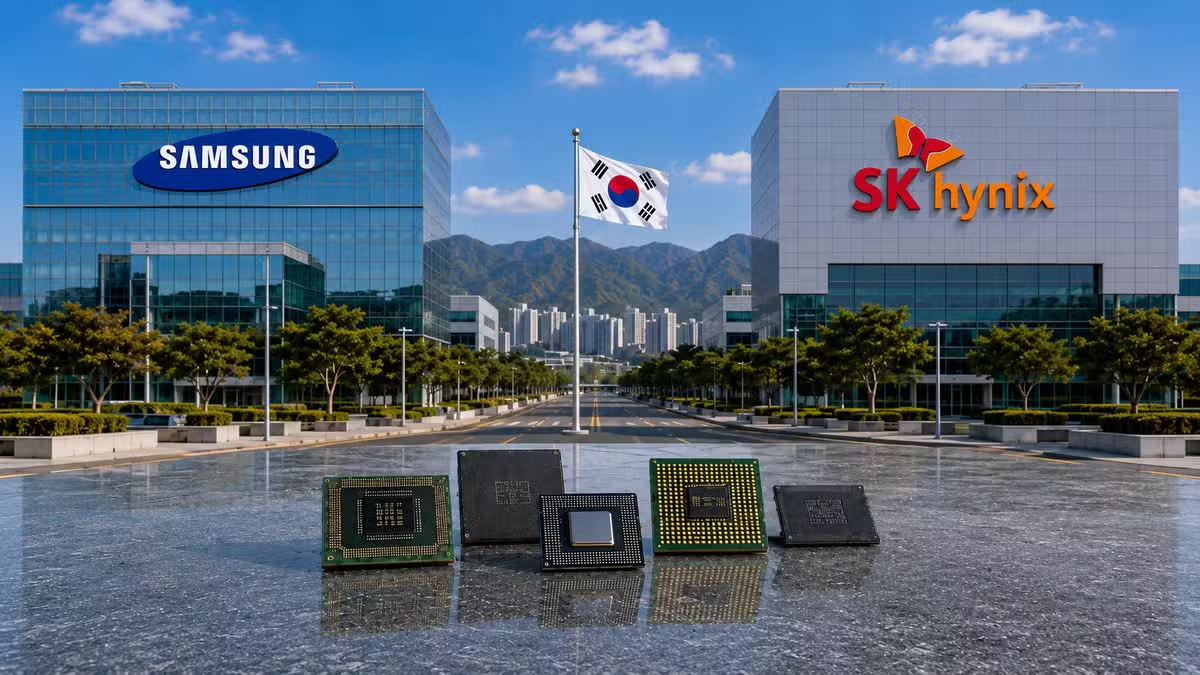
South Korea is preparing for one of the largest semiconductor investment drives in its history as Samsung and SK Hynix plan to invest approximately $518 billion (800 trillion won) to build four advanced memory chip fabrication plants in the country’s southwestern region. The ambitious initiative forms part of a broader national strategy to strengthen South Korea’s leadership in semiconductors, artificial intelligence (AI), and next-generation digital infrastructure.
The announcement was made during a presidential briefing attended by the chairmen of Samsung and SK Hynix, where the government outlined its long-term vision for expanding semiconductor manufacturing capacity and accelerating AI development.
The planned fabrication plants will be constructed in southwestern South Korea, a region that has traditionally received less semiconductor investment than established technology hubs such as Yongin and Pyeongtaek. Officials believe the expansion will promote balanced regional development while increasing the country’s production capacity for memory chips.
In addition to the new fabrication facilities, the national investment strategy includes another $52 billion for the development of a high-bandwidth memory (HBM) packaging hub in central South Korea. High-bandwidth memory has become a critical component for AI accelerators and advanced data center processors, making it one of the fastest-growing segments of the semiconductor industry.
The government’s roadmap extends beyond chip manufacturing. Major Korean companies, including SK Group, GS, and Naver, are expected to invest an additional $356 billion (550 trillion won) in AI data centers by 2035. Combined with semiconductor investments, South Korea’s technology sector has now committed more than $900 billion toward expanding AI infrastructure and supporting the growing global demand for advanced computing.
The surge in investment comes amid unprecedented demand for memory chips fueled by the rapid expansion of artificial intelligence. Samsung, SK Hynix, and U.S.-based Micron have benefited from a strong memory market as AI servers and high-performance computing systems require significantly larger amounts of DRAM and high-bandwidth memory than traditional computing platforms.
President Lee Jae Myung described semiconductors, physical AI, and AI data centers as the three pillars of South Korea’s next industrial era. During his address, he emphasized that existing semiconductor clusters in Yongin and Pyeongtaek are approaching their capacity limits, making it necessary to develop new manufacturing hubs in other parts of the country.
The president also dismissed speculation that the government had pressured private companies into making the investments. He stated that Samsung and SK Hynix reached their decisions independently, while the government’s responsibility is to create favorable conditions through infrastructure development, incentives, and regulatory support.
Separately, Samsung announced a long-term investment roadmap valued at approximately 2,655 trillion won (around $1.7 trillion) over the next decade. As part of this strategy, the company plans to invest 425 trillion won in the Honam region, including a new semiconductor fabrication plant in Gwangju. Samsung cited reliable access to electricity, water resources, skilled workers, and supportive infrastructure as key reasons for selecting the location.
The company also plans to establish a large AI data center in Haenam, further strengthening South Korea’s growing AI ecosystem.
Meanwhile, SK Group revealed its own investment roadmap worth approximately 2,100 trillion won (around $1.4 trillion). The conglomerate intends to allocate 1,100 trillion won toward expanding semiconductor production while investing another 1,000 trillion won in AI data centers across the country.
SK Hynix will lead the semiconductor expansion, while SK Telecom is expected to oversee the development of 15 gigawatts of AI data center capacity nationwide, supporting the increasing demand for cloud computing and AI services.
Despite the optimism surrounding these announcements, industry analysts note that semiconductor fabrication plants require years to construct and begin production. Market conditions may change significantly before the facilities become operational, creating the possibility of oversupply if demand slows. Such a scenario could put downward pressure on memory chip prices in the future.
Nevertheless, South Korea’s latest investment strategy demonstrates its determination to remain at the forefront of the global semiconductor industry. As AI adoption accelerates worldwide, the planned expansion is expected to play a significant role in meeting future demand for advanced memory chips while reinforcing the country’s position as a leading technology powerhouse.