
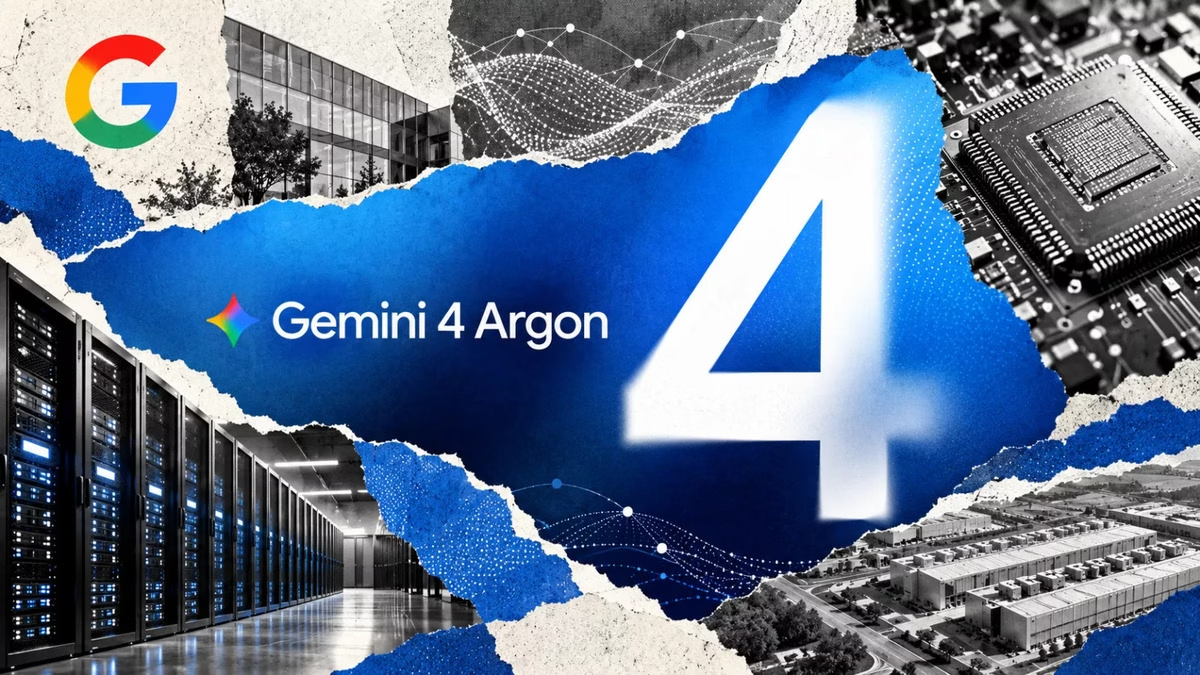
Google has unveiled Gemini 4 Argon, a new frontier artificial intelligence model designed for complex coding, research, enterprise work and cybersecurity tasks.
The model is being introduced as Google’s latest push into advanced AI, with the company highlighting its ability to handle long, multi-step workflows that require sustained reasoning and large amounts of information.
Google says Gemini 4 Argon delivers strong performance across software engineering, legal and financial knowledge work, and cybersecurity defense. The model is also designed to work with a context and output capacity of up to 1 million tokens, allowing it to process and generate substantially larger amounts of information in complex tasks.
The company has also emphasized Argon’s performance on software engineering benchmarks. Google reported a score of 77.9 percent on DeepSWE v1.1, a benchmark focused on real-world, long-horizon software engineering tasks.
In cybersecurity, Gemini 4 Argon has been developed to help defenders identify, validate and patch software vulnerabilities. Google says the model has already been used by internal teams and selected security partners for defensive cybersecurity work.
Argon’s initial rollout is deliberately limited. Google is providing access to a group of trusted cyber defenders through its Fairwind Program while it gathers feedback and continues testing its safety measures.
The company says it is also participating in the US government’s voluntary process for pre-release access to advanced AI models. Broader availability is planned later, beginning with paid API customers and Google AI Ultra subscribers before expanding further.
Pricing is another major part of Google’s launch strategy. Gemini 4 Argon has an introductory price of $2 per million input tokens and $10 per million output tokens. Google says the regular price after the introductory period will be $4 per million input tokens and $20 per million output tokens.
OpenAI’s published pricing for GPT-6 Astra lists $10 per million input tokens and $50 per million output tokens for standard API usage. This makes Argon’s introductory rates substantially lower on a per-token basis, although pricing alone does not determine which model is more suitable for a particular workload.
Google has also presented benchmark comparisons involving GPT-6 Astra. Its published results show Argon ahead on some evaluations while trailing on others, meaning claims that it universally outperforms Astra should be treated with care. Independent testing and broader real-world use will provide additional evidence as access expands.
The model is already being used inside Google for several demanding applications. Google says Argon agents have assisted with large-scale code migrations, research tasks and data-center optimization, including work that reportedly freed more than 300 TiB of memory after deployment.
Cybersecurity remains one of the model’s most prominent areas of focus. Google has introduced additional safeguards around the rollout because highly capable AI systems can potentially be misused. The company says it is strengthening protections against prompt injection and other risks while evaluating the model with early users.
The limited launch means most users cannot immediately access Gemini 4 Argon. Google plans to use feedback from trusted testers to improve safeguards and evaluate the model before making it available more widely.
The arrival of Gemini 4 Argon adds another major development to the rapidly evolving competition among advanced AI systems. Its combination of long-context reasoning, coding capabilities, cybersecurity applications and lower introductory pricing gives Google a new model aimed at demanding professional and enterprise workloads.
For developers and businesses, the next stage will be particularly important as Argon becomes available to a broader group of users. Wider testing will provide more information about its practical performance, cost efficiency and suitability across different AI applications.