


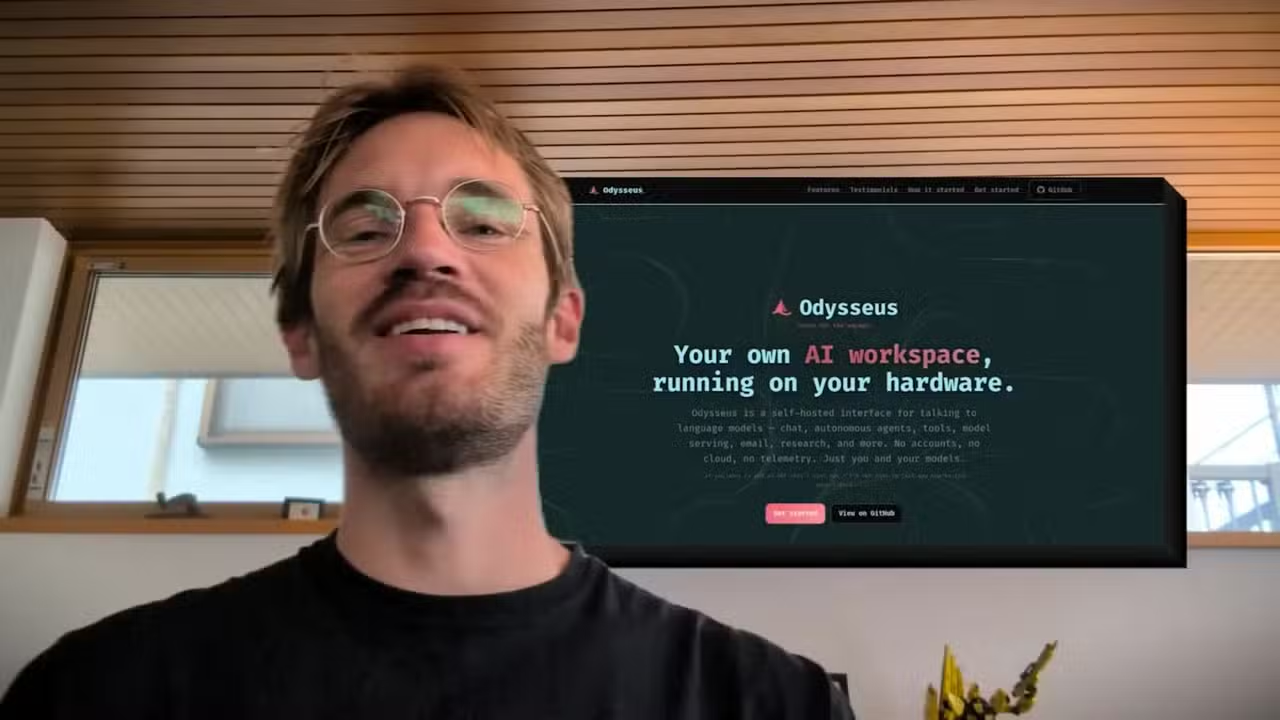
Popular YouTuber PewDiePie has entered the artificial intelligence space with the launch of Odysseus, a free and open-source AI workspace designed to give users greater privacy and control over how they interact with AI tools.
Unlike major AI platforms such as ChatGPT and Claude, Odysseus is not a new language model. Instead, it serves as a self-hosted interface that allows users to run and manage AI models on their own computers. The platform is designed for people who want to use AI without relying entirely on third-party cloud services.
The key feature that sets Odysseus apart is its focus on privacy and user control. Rather than routing conversations, files, and prompts through external company servers, the workspace enables users to process information locally on their own machines. This approach appeals to individuals who are concerned about data privacy and want more ownership over their AI workflows.
Odysseus supports both local and cloud-based AI options, giving users flexibility in how they deploy AI tools. According to the project’s documentation, it is compatible with a range of popular AI frameworks and providers, including OpenAI, GitHub Copilot, Ollama, OpenRouter, vLLM, and llama.cpp.
This means users can choose to run open-source models directly on their devices or connect to external APIs depending on their needs and hardware capabilities. The project’s creators describe Odysseus as a “local-first” and “privacy-first” workspace that operates without telemetry, emphasizing transparency and user autonomy.
The launch reflects a growing trend within the AI industry toward self-hosted and decentralized solutions. As artificial intelligence becomes more integrated into everyday work and personal projects, many users are seeking alternatives that provide greater control over data handling and system configuration.
Industry observers note that while Odysseus does not directly compete with the underlying AI models developed by companies such as OpenAI or Anthropic, it does compete in the user experience layer by offering a different way to access and manage AI technologies.
For developers, privacy-conscious users, and AI enthusiasts, Odysseus could represent an attractive alternative to traditional cloud-based AI platforms, particularly for tasks involving sensitive information or customized workflows.