


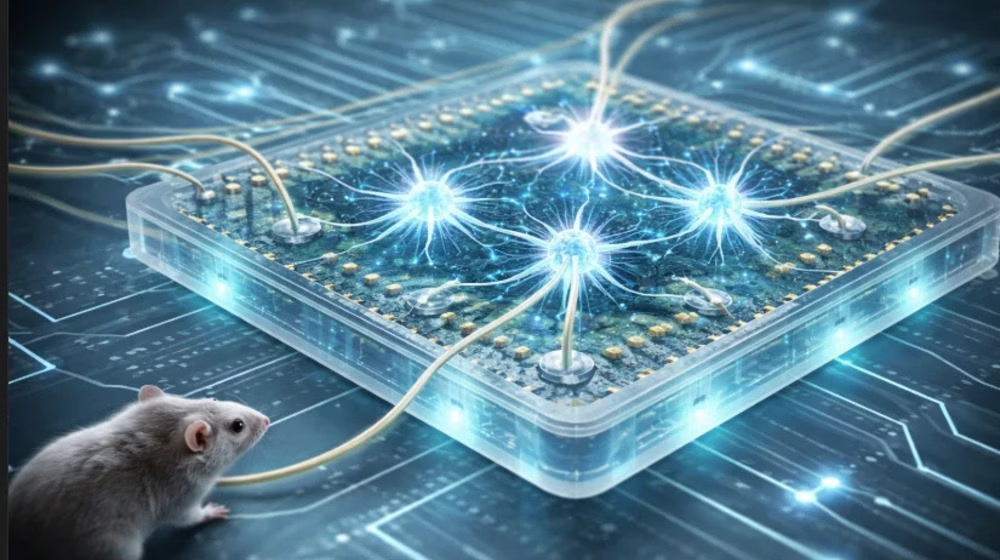
In a groundbreaking development, researchers have successfully created a bio-AI system using living rat cortical neurons to perform real-time computational tasks. This innovative study combines biological neural networks with advanced machine learning techniques, demonstrating the potential of living cells as functional computing units.
The system operates through a closed-loop reservoir computing approach, allowing neurons to process and adapt to computational inputs continuously. By integrating living brain cells with high-density microelectrode arrays and microfluidic devices, the researchers are able to monitor and manipulate neural activity with unprecedented precision. Neural signals are recorded, converted into continuous outputs, and then fed back into the system as electrical stimulation, enabling dynamic learning and computation.
Experts suggest that this method could redefine the future of artificial intelligence and computing. Unlike conventional silicon-based processors, living neurons offer inherent adaptability, energy efficiency, and parallel processing capabilities, making them uniquely suited for complex, real-time tasks. The research highlights the potential of biohybrid systems to address problems that traditional computers struggle to solve efficiently.
While the technology is still in its experimental stage, the implications are far-reaching. Applications could extend to neuromorphic computing, advanced robotics, and even medical research, where understanding neural computation can lead to better treatments for brain disorders. Combining living neurons with AI algorithms opens new frontiers for both neuroscience and computational technology.
The team emphasizes that ethical considerations are paramount, as working with living brain tissue demands strict compliance with research guidelines. Nevertheless, the study demonstrates a remarkable convergence of biology and computer science, paving the way for future hybrid computing systems that leverage the best of both worlds.